This week in anatomy
On this day · 22/5/1954 (gregorian)
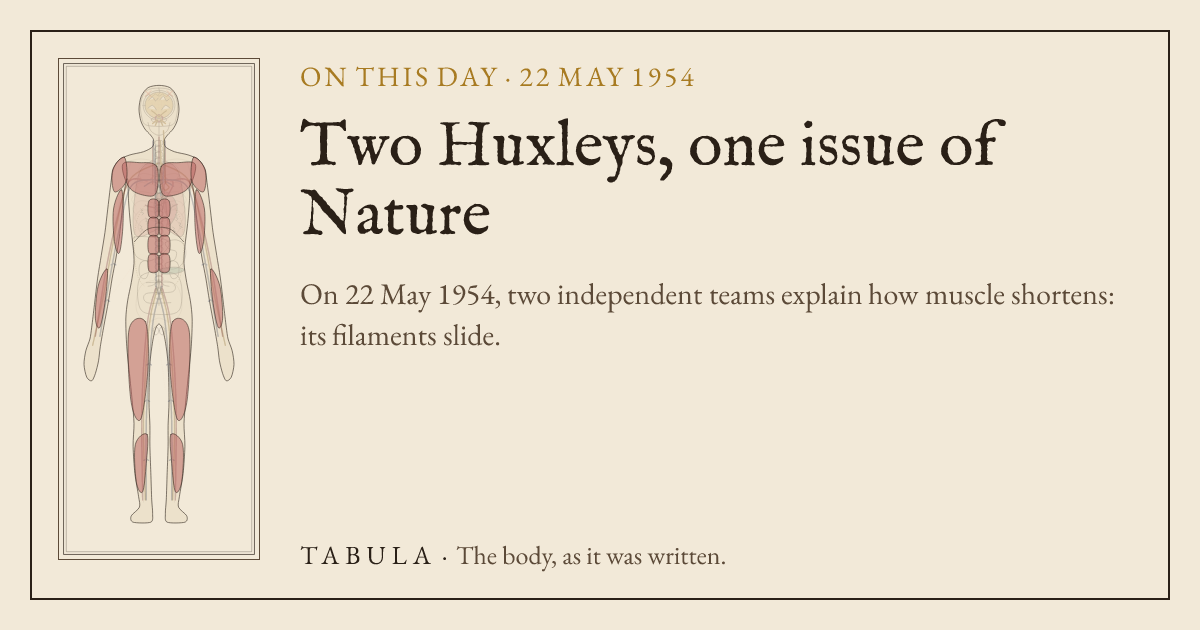
Tab. XXIV: Two Huxleys, one issue of Nature
On this day in 1954, Nature printed two papers side by side explaining how muscle contracts. Their authors included two unrelated Huxleys.
This week · week 1
Tab. I: The first word for "brain"
A surgeon's case notes name the brain and the membranes around it.
This week · week 2
Islamic world (Galenic anatomy): The Tashrīḥ-i Manṣūrī
Written in Persian in Shiraz and dedicated to Pir Muhammad Bahadur, ruler of Fars, this is the first known Islamic anatomical text to illustrate the whole body. The National Library of Medicine holds a copy completed in 1488.
This week · week 3
A belief of its time: Arteries carry pneuma, not blood
Followers of Erasistratus held that the arteries carry an air-like pneuma, and that blood appears in a cut artery only because it rushes in from the veins.
This week · week 4
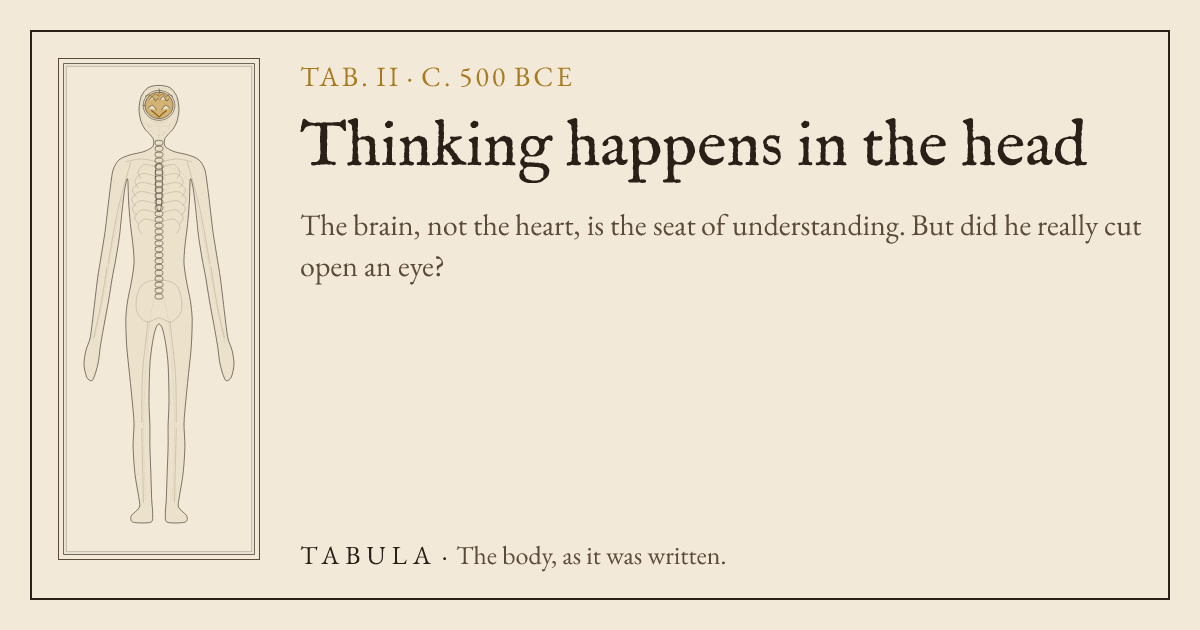
Tab. II: Thinking happens in the head
The brain, not the heart, is the seat of understanding. But did he really cut open an eye?
This week · week 5
Islamic world (Galenic anatomy): The system of bones
The first of the five system-figures maps the skeleton. The bones are named and described as a framework.
This week · week 6
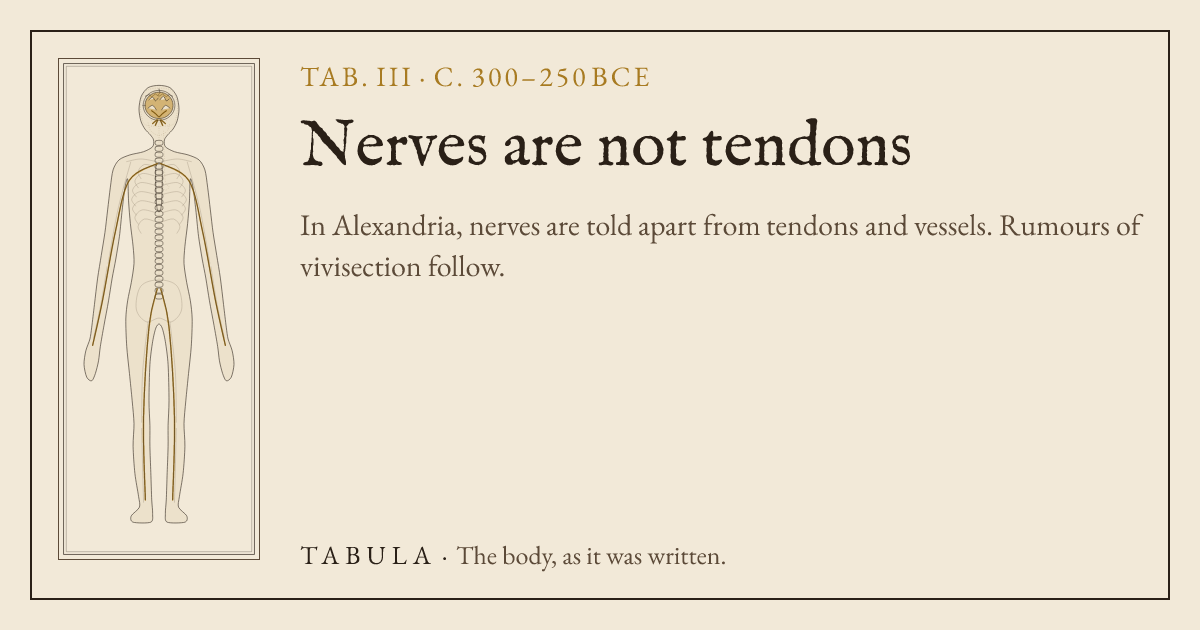
Tab. III: Nerves are not tendons
In Alexandria, nerves are told apart from tendons and vessels. Rumours of vivisection follow.
This week · week 7
Islamic world (Galenic anatomy): The system of nerves
The nerve figure shows nerves arising from the brain and spinal cord, following Galen's account of how sensation and movement are carried.
This week · week 8
Islamic world (Galenic anatomy): The system of veins
The veins are drawn as a separate system. In Galenic anatomy they rise from the liver and carry nourishing blood outwards. Compare the red-ink belief on the modern figure.
This week · week 9
Tab. V: Anatomy, layer by layer
A method for studying the body. Soften it in water, then scrape away one layer at a time.
This week · week 10
A belief of its time: Pores in the heart's wall
Blood seeps from the right to the left side of the heart through invisible pores in the septum.
This week · week 11
Tab. IV: The circulation that wasn't
Did Chinese medicine describe the circulation of the blood 2,000 years before Harvey? Not in the way the claim suggests.
This week · week 12
Islamic world (Galenic anatomy): The system of arteries
The arteries are drawn as a system of their own, separate from the veins, rising from the heart as Galen taught.
This week · week 13
Classical Chinese (channels and points): The Bronze Man
The court physician Wang Weiyi oversaw the casting of bronze acupuncture figures and the writing of a three-volume illustrated book, completed around 1027. Together they set a national standard for where the channels and points lie.
This week · week 14
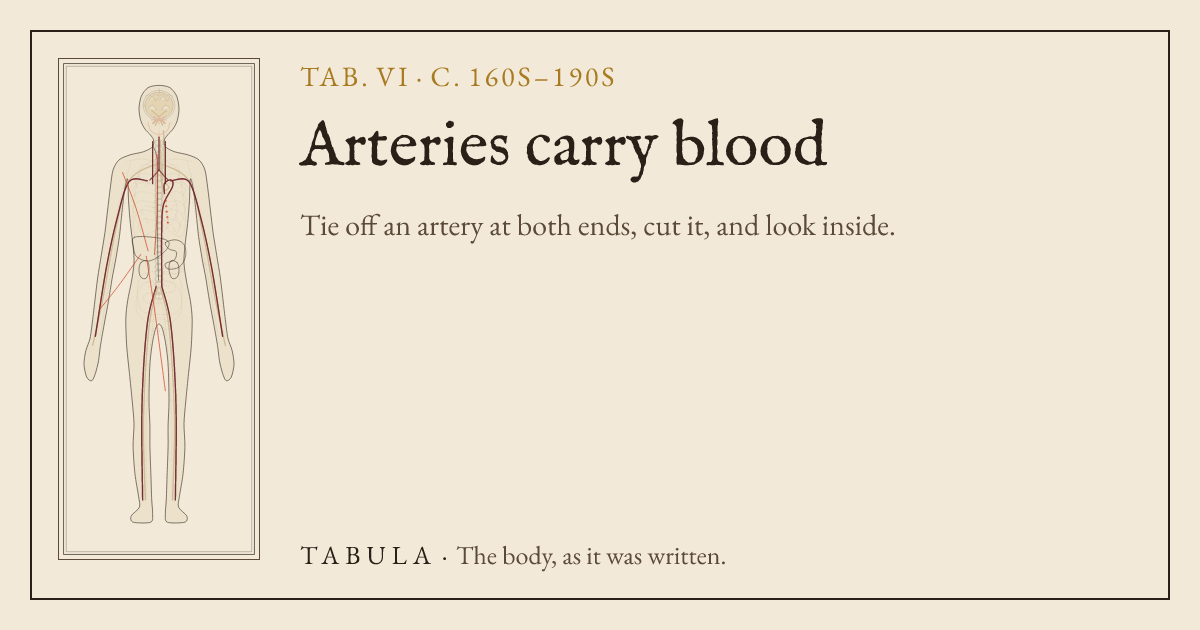
Tab. VI: Arteries carry blood
Tie off an artery at both ends, cut it, and look inside.
This week · week 15
Classical Chinese (channels and points): A body that tested students
For teaching and examinations the figure was coated in wax and filled with water. A needle placed on the right point released a drop of fluid.
This week · week 16
Tab. VII: The squealing pig falls silent
Before an audience in Rome, Galen cuts one nerve and a pig loses its voice.
This week · week 17
Classical Chinese (channels and points): Channels named for organs
The woodcuts trace channels across the body, each named for an organ and a limb: the lung channel of the hand taiyin, the heart-envelope channel, the gallbladder and bladder channels of the foot.
This week · week 18
A belief of its time: A "wonderful net" under the human brain
A network of vessels at the base of the brain, the rete mirabile, refines vital spirit into animal spirit.
This week · week 19
Tab. VIII: Light comes into the eye
The eye doesn't shoot out rays. Light from every point of an object enters it.
This week · week 20
Classical Chinese (channels and points): Qi in the vessels
In the classical texts the vessels carry qi, and only sometimes blood. This is a model of flow and correspondence, not a pump-and-pipes circulation. That's why Tab. IV is marked Revised.
This week · week 21
Tab. XXIV: Two Huxleys, one issue of Nature
On 22 May 1954, two independent teams explain how muscle shortens: its filaments slide.
This week · week 22
Tab. IX: No pores in the septum
Blood can't seep through the heart's wall, so it must go through the lungs. The manuscript was lost to sight until 1924.
This week · week 23
Classical Chinese (channels and points): Where not to needle
Woodcuts dated 1443 from the same tradition set out rules for points that must not be needled, a reminder that the system was practical medicine with safety rules.
This week · week 24
Classical Chinese (channels and points): The Four Flower points
Another 1443 woodcut shows how to locate the "Four Flower" points by measuring the body itself. Proportion stands in for a ruler.
This week · week 25
Tab. X: Whirlpools close the valve
Leonardo worked out how the aortic valve shuts, and almost nobody saw it for centuries.
This week · week 26
A belief of its time: The lower jaw is two bones
The human lower jaw is made of two bones joined at the chin.
This week · week 27
Tab. XI: Galen dissected apes
Vesalius shows that much of the anatomy everyone learned came from animals.
This week · week 28
Ayurveda: The Ayurvedic Man
A gouache painting of a male body, probably made in Kathmandu around 1800, now in the Wellcome Collection (ref. 574912i). It was exhibited in London in 2017–18.
This week · week 29
Ayurveda: Physician, painters and a scribe
The painting was probably a collaboration between an Ayurvedic physician, Tibetan artists and a calligrapher in Kathmandu. The calligrapher may not have known Sanskrit well.
This week · week 30
Tab. XII: Three Europeans and a suppressed book
In the 1550s the lung circuit is described again, in Europe, and the argument over who was first begins.
This week · week 31
Ayurveda: Organs as receptacles
The organs on the torso are drawn as receptacles, each holding one of the body's fluids. It is a physiology of containers and flows.
This week · week 32
Tab. XIII: A trumpet, not a seminal duct
Falloppio describes the uterine tubes, and corrects his hero Vesalius.
This week · week 33
Ayurveda: Channels
Channels run across the torso, carrying the body's fluids between the receptacles. This is the Ayurvedic idea of the body as a network of passages.
This week · week 34
A belief of its time: Valves slow the outward flow
The valves of the veins act as brakes on blood flowing outwards from the liver, so it does not pool in the hands and feet.
This week · week 35
Tab. XIV: Perfectly described, completely misread
Fabricius draws the little doors in the veins and gets their purpose backwards.
This week · week 36
Ayurveda: Words from the Bhāvaprakāśa
The Sanskrit captions are taken from the Bhāvaprakāśa, an Ayurvedic compendium by Bhāvamiśra. Its date is itself uncertain. The catalogue says 1550–1590, and the leading study says around 1650–90.
This week · week 37
Tab. XV: The milky veins
A well-fed dog reveals a whole new set of vessels, which Aselli then sends to the wrong organ.
This week · week 38
Ayurveda: Read the picture and the text together
The image isn't a free-standing anatomical drawing. Its meaning depends on the Sanskrit around it, and the leading study argues they have to be read as one work.
This week · week 39
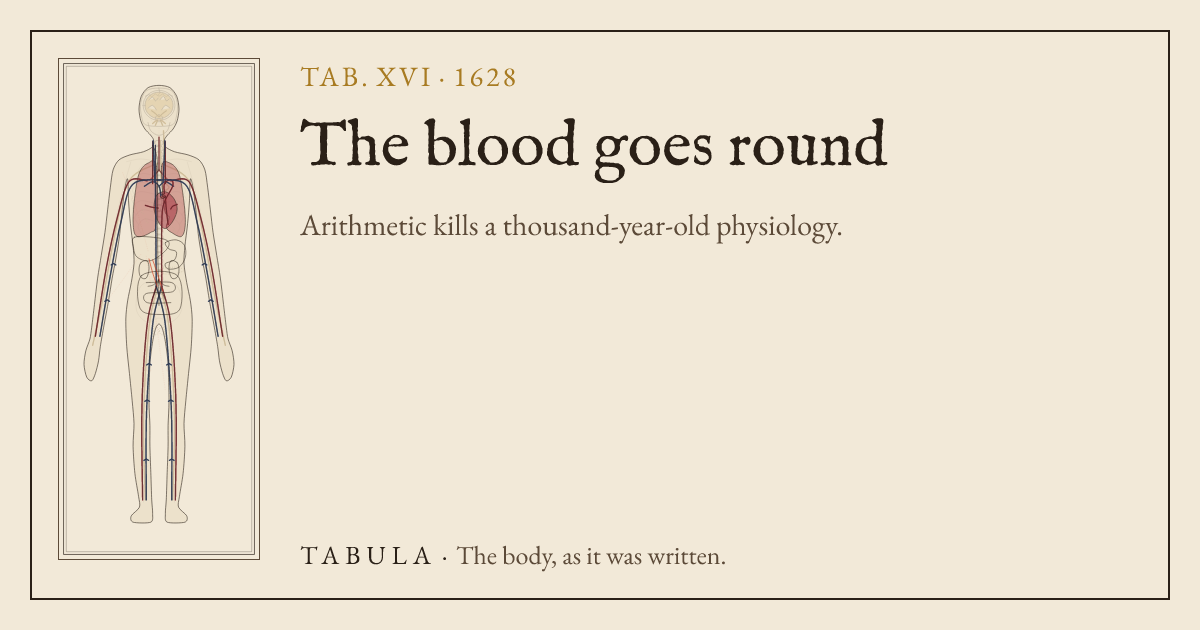
Tab. XVI: The blood goes round
Arithmetic kills a thousand-year-old physiology.
This week · week 40
A belief of its time: The liver makes the blood, and the body uses it up
Blood is made continuously in the liver from digested food, flows outwards through the veins and is consumed by the tissues.
This week · week 41
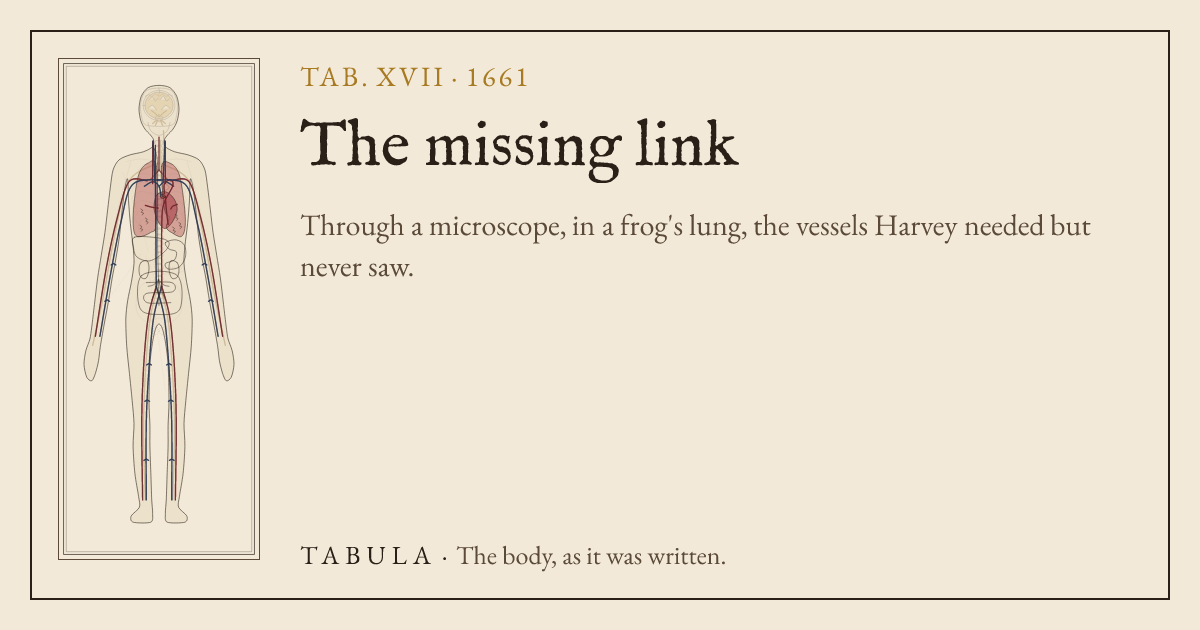
Tab. XVII: The missing link
Through a microscope, in a frog's lung, the vessels Harvey needed but never saw.
This week · week 42
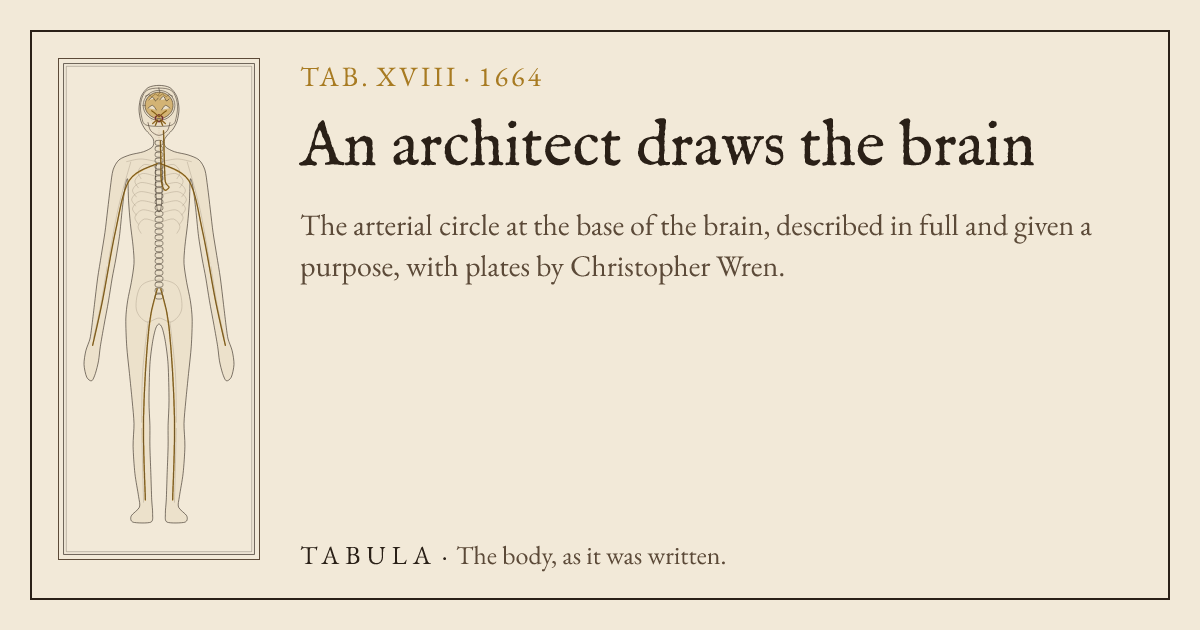
Tab. XVIII: An architect draws the brain
The arterial circle at the base of the brain, described in full and given a purpose, with plates by Christopher Wren.
This week · week 43
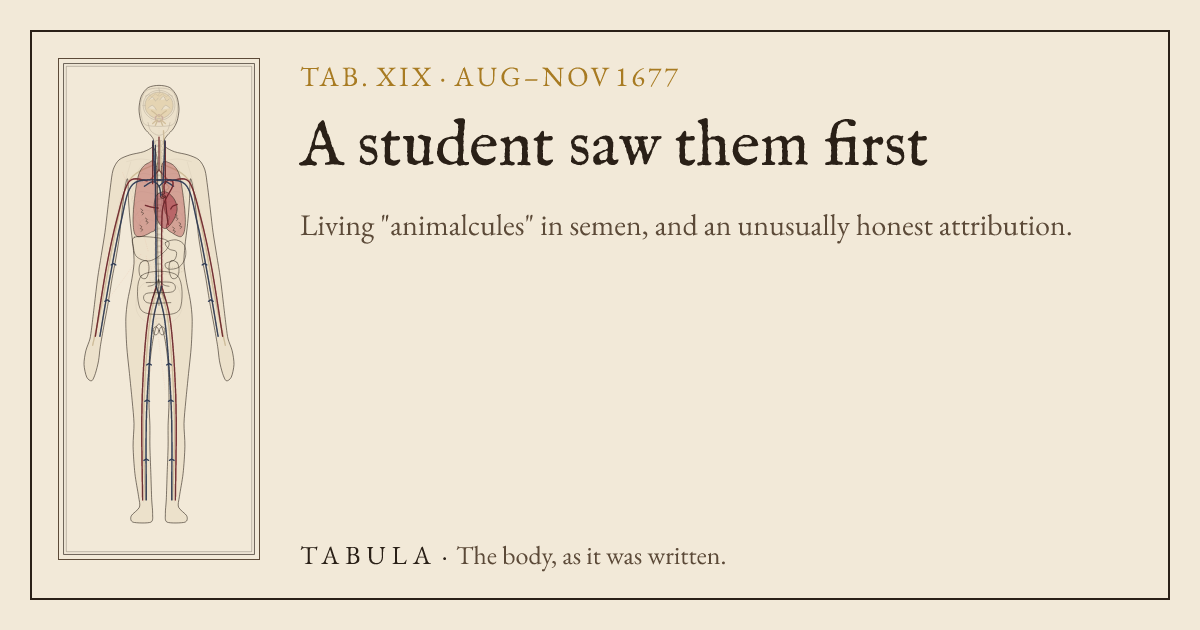
Tab. XIX: A student saw them first
Living "animalcules" in semen, and an unusually honest attribution.
This week · week 44
A belief of its time: The milky veins run to the liver
The lacteals carry chyle from the gut to the liver, where it is made into blood.
This week · week 45
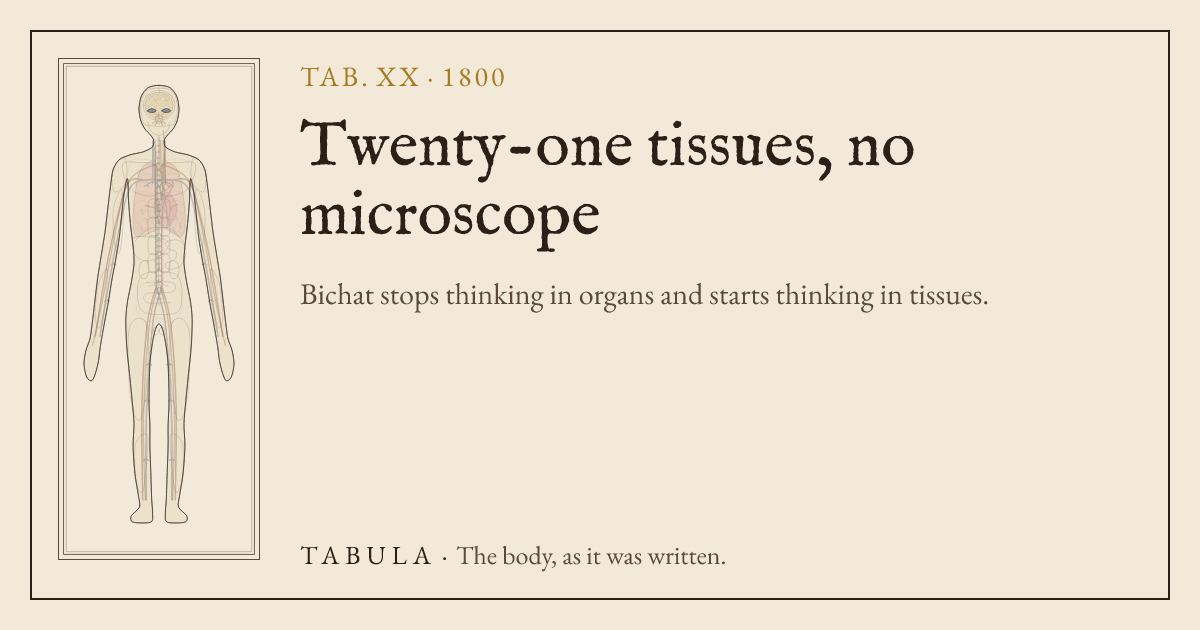
Tab. XX: Twenty-one tissues, no microscope
Bichat stops thinking in organs and starts thinking in tissues.
This week · week 46
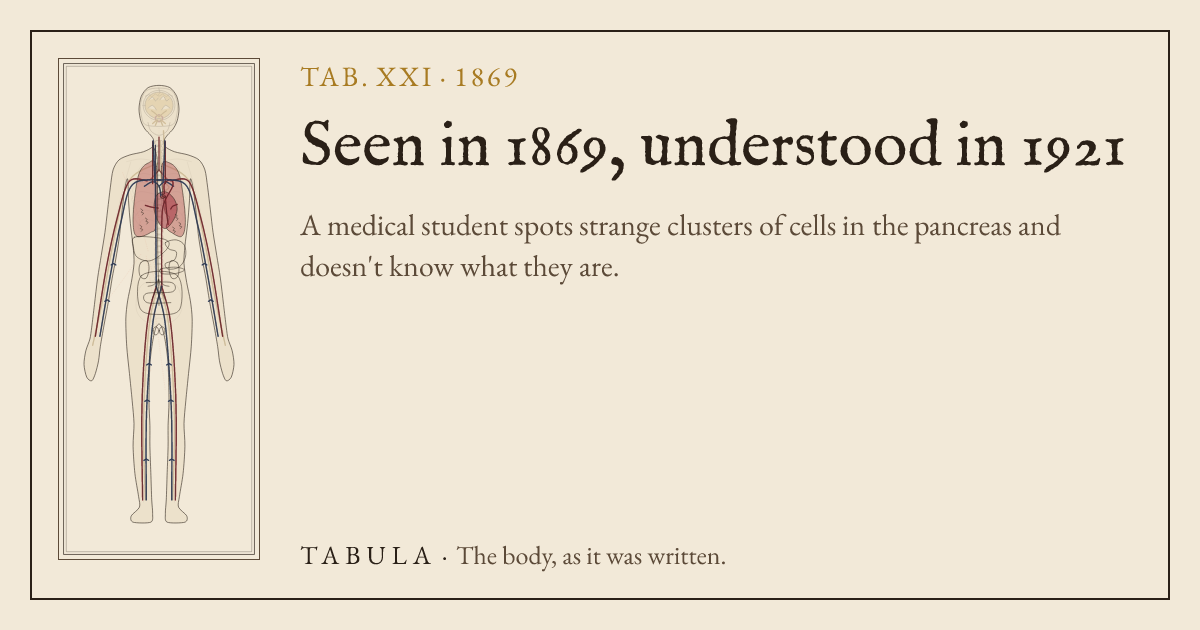
Tab. XXI: Seen in 1869, understood in 1921
A medical student spots strange clusters of cells in the pancreas and doesn't know what they are.
This week · week 47
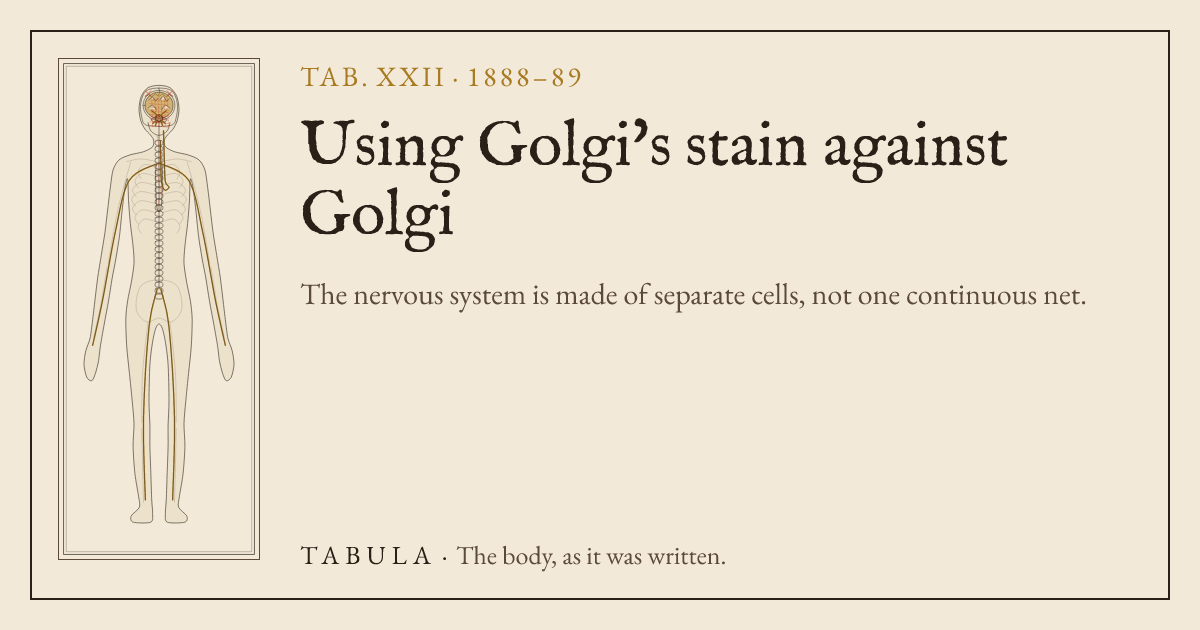
Tab. XXII: Using Golgi's stain against Golgi
The nervous system is made of separate cells, not one continuous net.
This week · week 48
A belief of its time: The nervous system is one continuous net
Nerve fibres fuse into a single continuous network rather than being made of separate cells.
This week · week 49
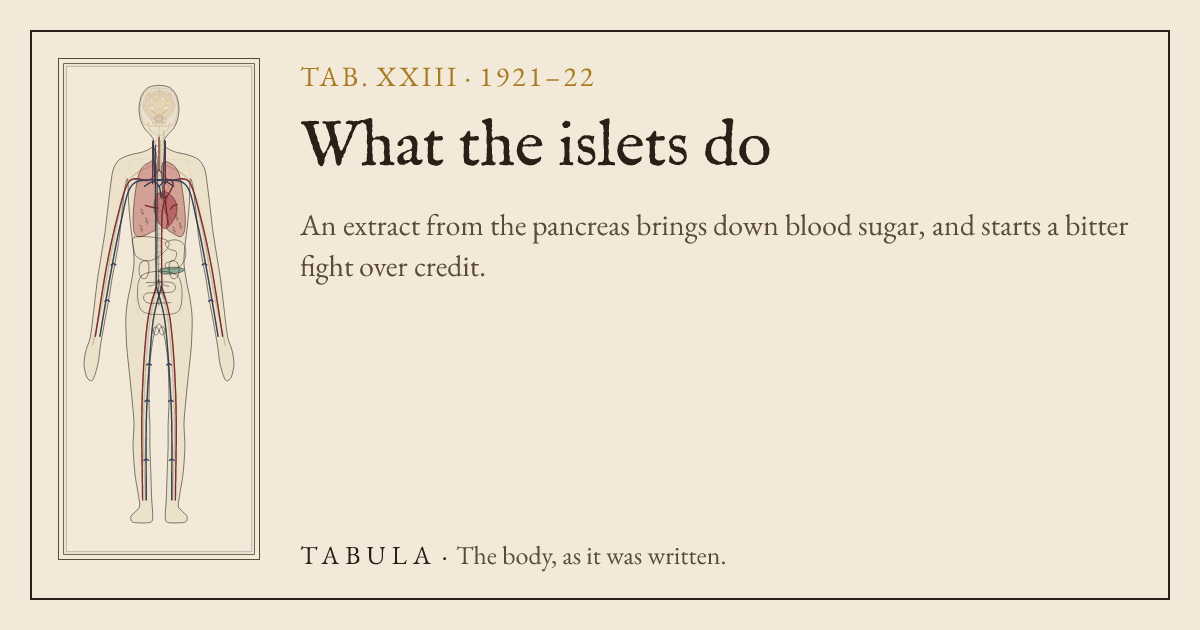
Tab. XXIII: What the islets do
An extract from the pancreas brings down blood sugar, and starts a bitter fight over credit.
This week · week 50
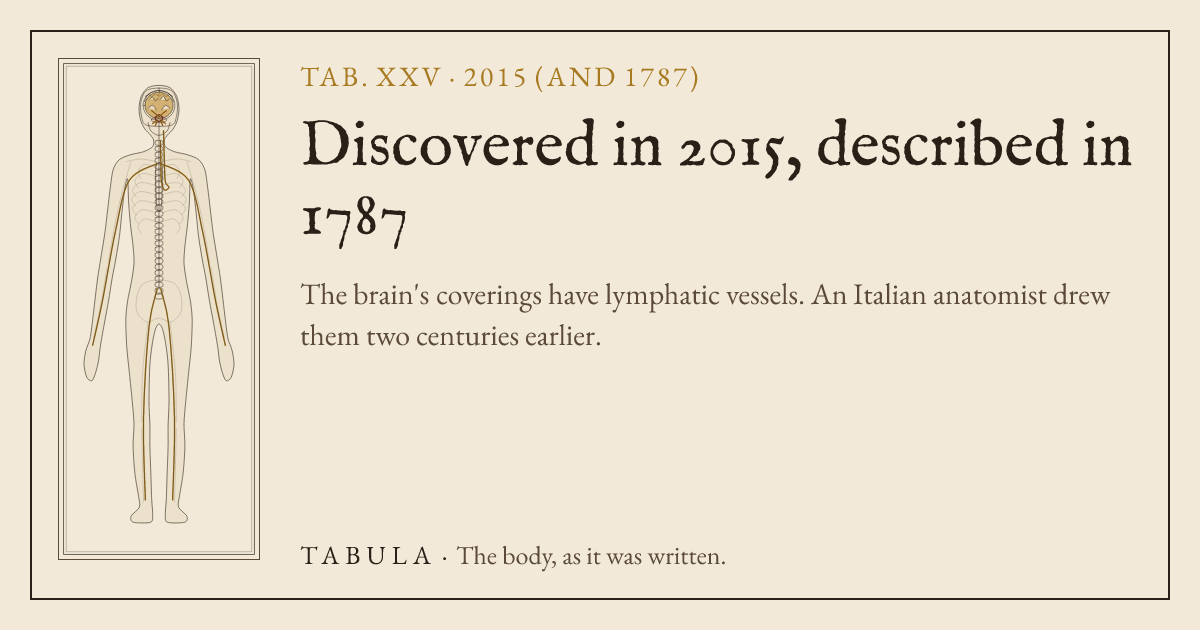
Tab. XXV: Discovered in 2015, described in 1787
The brain's coverings have lymphatic vessels. An Italian anatomist drew them two centuries earlier.
This week · week 51
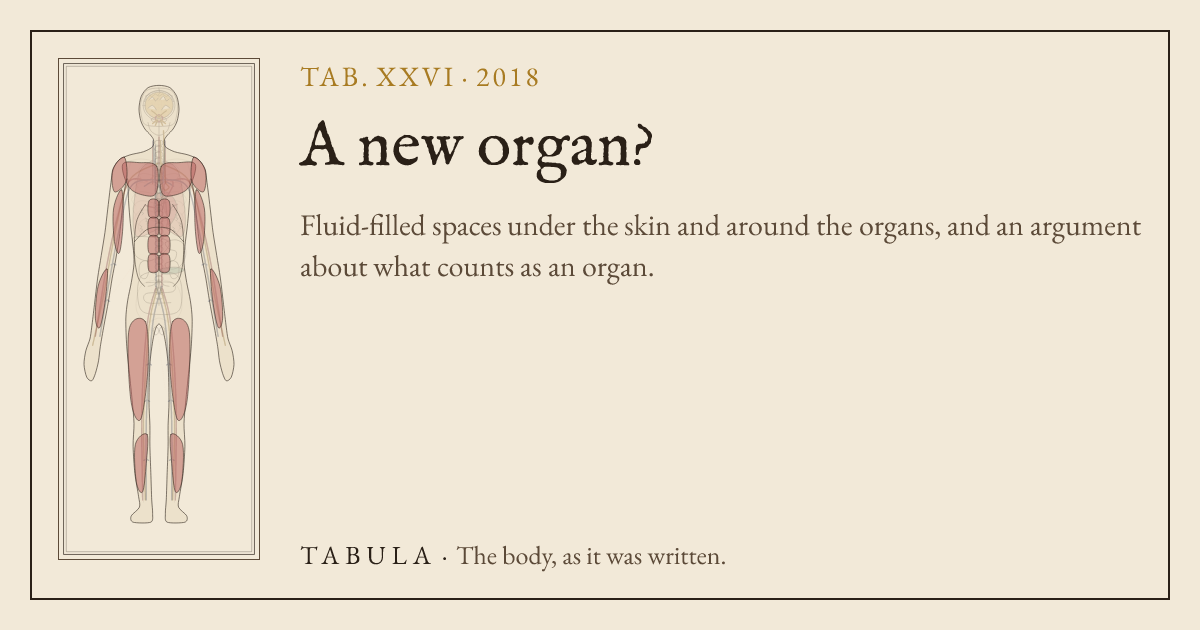
Tab. XXVI: A new organ?
Fluid-filled spaces under the skin and around the organs, and an argument about what counts as an organ.
This week · week 52
A belief of its time: The brain has no lymphatic vessels
The brain and its coverings lack lymphatic vessels and drainage.